
Signature Resource: Evergreen public safety education from the StopAiFraud Foundation.
The Crime We Don’t See Is the Hardest to Stop: America’s Hidden Senior Fraud Crisis
Billions of dollars are lost to financial fraud. But what if the losses we know about represent only a fraction of the real problem?
By StopAiFraud Foundation | Public Safety & Fraud Prevention
When a home is burglarized or a vehicle is stolen, the owner may quickly recognize that a crime has occurred. Financial fraud can be different. A victim may not realize they have been deceived for weeks or months. Others discover the crime but never report it because of embarrassment, fear or uncertainty about where to turn.
This creates a dangerous blind spot in America’s ability to defend against financial fraud.
The tip of the iceberg
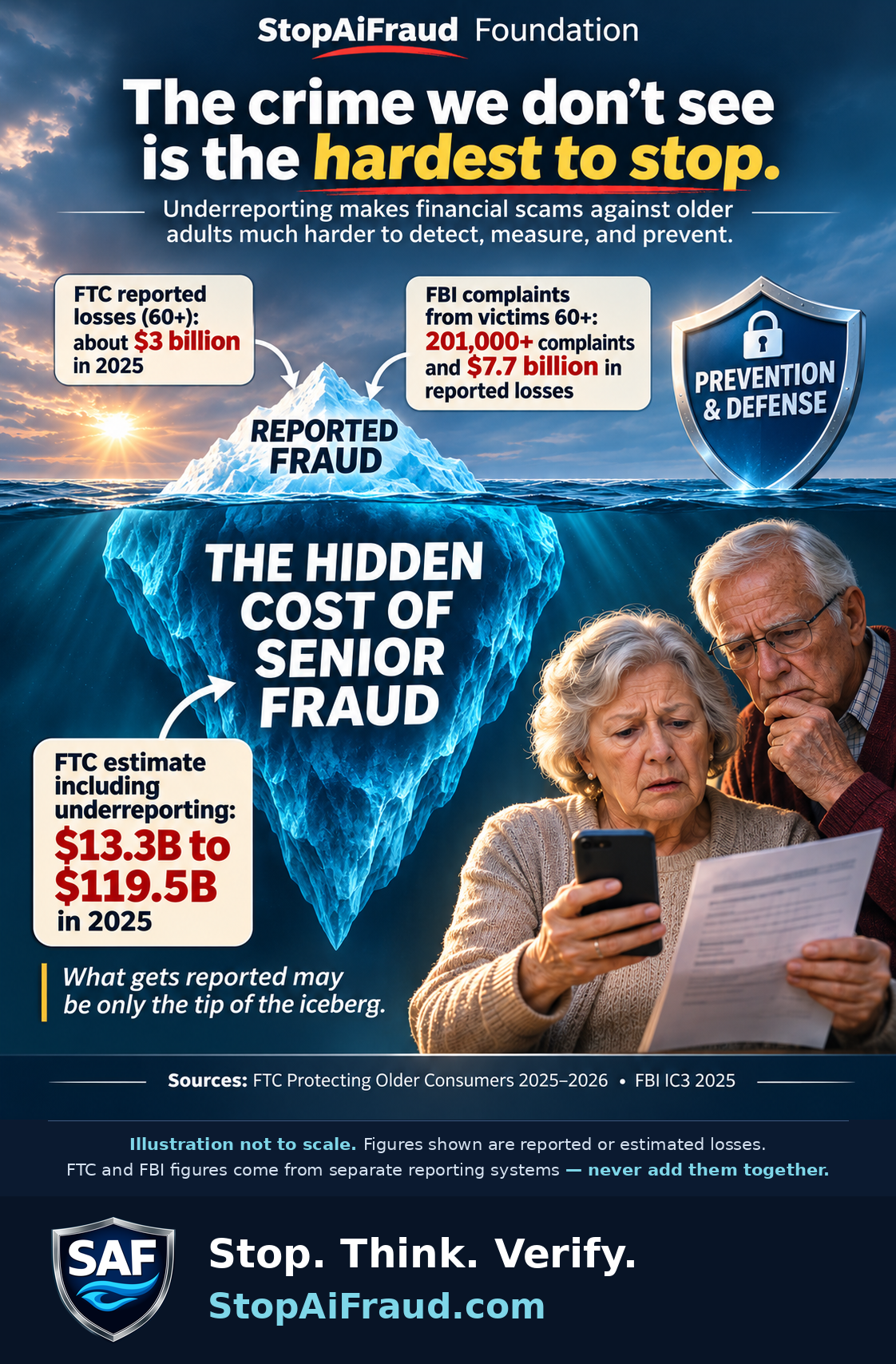
According to the FBI and the Federal Trade Commission (FTC), the financial impact of fraud against older Americans is staggering.
In 2025:
- More than 201,000 elder fraud complaints were submitted to the FBI’s Internet Crime Complaint Center (IC3).
- Reported losses exceeded $7.7 billion, up 59% compared with 2024, according to the FBI’s elder fraud summary.
- The FTC recorded approximately $3 billion in reported fraud losses among adults aged 60 and older through its separate Consumer Sentinel analysis.
However, the FTC estimates that the overall cost of fraud to older Americans in 2025 could be between $13.3 billion and $119.5 billion, depending on assumptions about underreporting. These estimates carry considerable uncertainty, but demonstrate how incomplete the reported figures may be. The FBI and FTC use separate reporting systems; their figures should not be added together.
What we see may be only the tip of the iceberg.
Protect yourself and your community
Check your own risk in a few minutes, or invite the StopAiFraud Foundation to bring fraud prevention education to your group.
Why seniors may not report financial fraud
There are several reasons why victims may remain silent:
- Embarrassment about being deceived.
- Fear of losing financial independence or being judged by family members.
- Uncertainty about where to report the crime.
- Failure to recognize that a crime has occurred.
- Belief that the stolen money cannot be recovered.
- Manipulation by criminals who demand secrecy.
Fraudsters exploit fear, urgency and isolation to discourage victims from seeking help. Victims deserve support, not judgment. Being deceived by a sophisticated criminal does not diminish a person’s intelligence, dignity or independence.
Why underreporting makes fraud harder to fight
Public safety depends on information. When financial crimes go unreported, investigators, financial institutions and community organizations may have an incomplete understanding of the threats facing the public.
Underreporting can make it more difficult to identify emerging scam patterns, connect crimes committed against multiple victims, recognize organized criminal networks, issue timely community warnings, allocate prevention and investigative resources, and intervene before additional victims lose money.
Every unreported incident may represent a missed opportunity to protect someone else.
Reporting fraud is not simply about recovering stolen money. It is also about helping prevent the next crime.
Artificial intelligence is increasing the challenge
The expansion of artificial intelligence introduces new capabilities that criminals can misuse, including realistic voice cloning, convincing impersonation messages, manipulated videos and personalized fraudulent communications.
A grandmother may receive a call that sounds like her grandson. A retiree may see a convincing video promoting a fraudulent investment. A bank customer may receive a message that appears to come from their financial institution.
Not every scam involves artificial intelligence. But AI can make existing criminal techniques more convincing and easier to deploy at scale. As deception becomes more sophisticated, independent verification becomes increasingly important.
We cannot rely on reporting alone
Reporting is essential, but it generally occurs after a suspicious encounter or financial loss. That is why the StopAiFraud Foundation emphasizes pre-incident education — helping individuals recognize suspicious patterns and interrupt fraudulent interactions before criminals succeed.
We believe fraud prevention must become an everyday public safety habit, much like wearing a seat belt or checking a smoke detector.
STOP. Do not allow someone to pressure you into making an immediate financial decision.
THINK. Ask yourself why this person is contacting you, what they want and whether their request makes sense.
VERIFY. Contact the person, bank, business or government agency independently using a trusted telephone number or official website. Never rely exclusively on caller ID, an incoming message or the voice you hear.
Make the call. Don’t take the call.
Reporting a scam can protect someone else
If you encounter suspected fraud, report it — even if you recognized the scam before losing money. If money has been transferred, immediately contact your bank or financial institution using its official telephone number. Preserve relevant messages, receipts, telephone numbers and transaction records.
Official reporting resources:
- National Elder Fraud Hotline: 1-833-372-8311.
- FBI Internet Crime Complaint Center: https://www.ic3.gov/
- Federal Trade Commission: https://reportfraud.ftc.gov/
If you suspect financial exploitation by a caregiver, relative or other trusted person, you can also contact your local Adult Protective Services agency. Families should encourage these conversations without criticism or shame.
A call to America’s institutions
Banks, credit unions, insurance agencies, senior living communities, libraries, churches and public transportation agencies all have opportunities to strengthen fraud prevention.
These institutions interact with millions of Americans before, during and after potential scam encounters. By incorporating fraud awareness into everyday environments, they can help reach people who may never actively search for cybersecurity education.
We must bring prevention to the people rather than waiting for people to become victims.
The StopAiFraud Foundation commitment
Our mission is to empower individuals and communities with practical knowledge that helps them recognize and interrupt fraud before financial harm occurs.
We cannot eliminate every scam. But we can work together to make deception less effective. The true scale of financial fraud may remain difficult to measure. Our commitment to preventing it should not.
AI made fraud smarter. We make people smarter than the fraud.
Stop. Think. Verify.
Take our Free Safety Check or invite the StopAiFraud Foundation to provide fraud prevention education to your community.
Sources
- FTC, Protecting Older Consumers 2025–2026 (October 2026): https://www.ftc.gov/reports/protecting-older-consumers-2025-2026-report-federal-trade-commission
- FBI, Scammers Target Older Adult Victims: https://www.fbi.gov/news/stories/scammers-target-older-adult-victims
- DOJ, Financial Exploitation: https://www.justice.gov/elderjustice/financial-exploitation
Stop. Think. Verify.
Take our Free Safety Check or invite the StopAiFraud Foundation to provide fraud prevention education to your community.